
.svg)
User Experience Design

4 March 2026
How might we improve the work order completion rate from 50% to more than 90%, and contribute to the 10% experience growth target

Enterprise platforms don’t grow because they’re powerful.
They grow because people can execute their work efficiently inside them.
This is the story of how redesigning the mobile execution layer of IBM Maximo Application Suite (MAS) increased work order completion from 50% to over 90% — and directly contributed to measurable customer growth.
IBM leadership set a clear target:
Increase overall Maximo customer growth by 10% year-over-year.
This wasn’t just a sales goal. It was a product experience challenge.
In asset management, value is realized only when work gets completed. If execution fails, growth stalls.
MAS delivers value across four core areas:
We focused on Field Service Management, where work orders move from planning to real-world execution.
FSM operates across three applications:
Scheduling and dispatching were stable.
Execution was not.
Despite proper planning, over 50% of work orders were not reaching completion.
The breakdown was happening in the last mile — in the hands of technicians.
That’s where UX had leverage.
I led UX design for Maximo Mobile.
Designing for mobile in enterprise environments means designing for:
If the mobile experience fails, execution fails.
If execution fails, customer value disappears.
Our core persona was ELI — a maintenance technician.
ELI:
ELI doesn’t care about backend architecture.
ELI cares about getting the job done.
We designed around that reality.
We moved into structured discovery with four goals:
We triangulated insights from:
We uncovered 7+ critical insights.
Work orders were started — but frequently abandoned due to execution and reporting friction.
The reporting page felt complex and error-prone.
Technicians avoided completing it.
This compromised data integrity.
Technicians left the app to gather information — increasing abandonment.
Many customers operated in crews.
The system only supported individual assignments.
Dispatchers couldn’t see who was available.
Work orders were sent to unavailable technicians.
Industries managing pipelines, railways, and utilities lacked proper support.
This limited enterprise adoption in high-value sectors.
We categorized initiatives into:
We evaluated each epic by:
This structured prioritization ensured alignment with IBM’s growth strategy.
We followed a four-phase design framework:
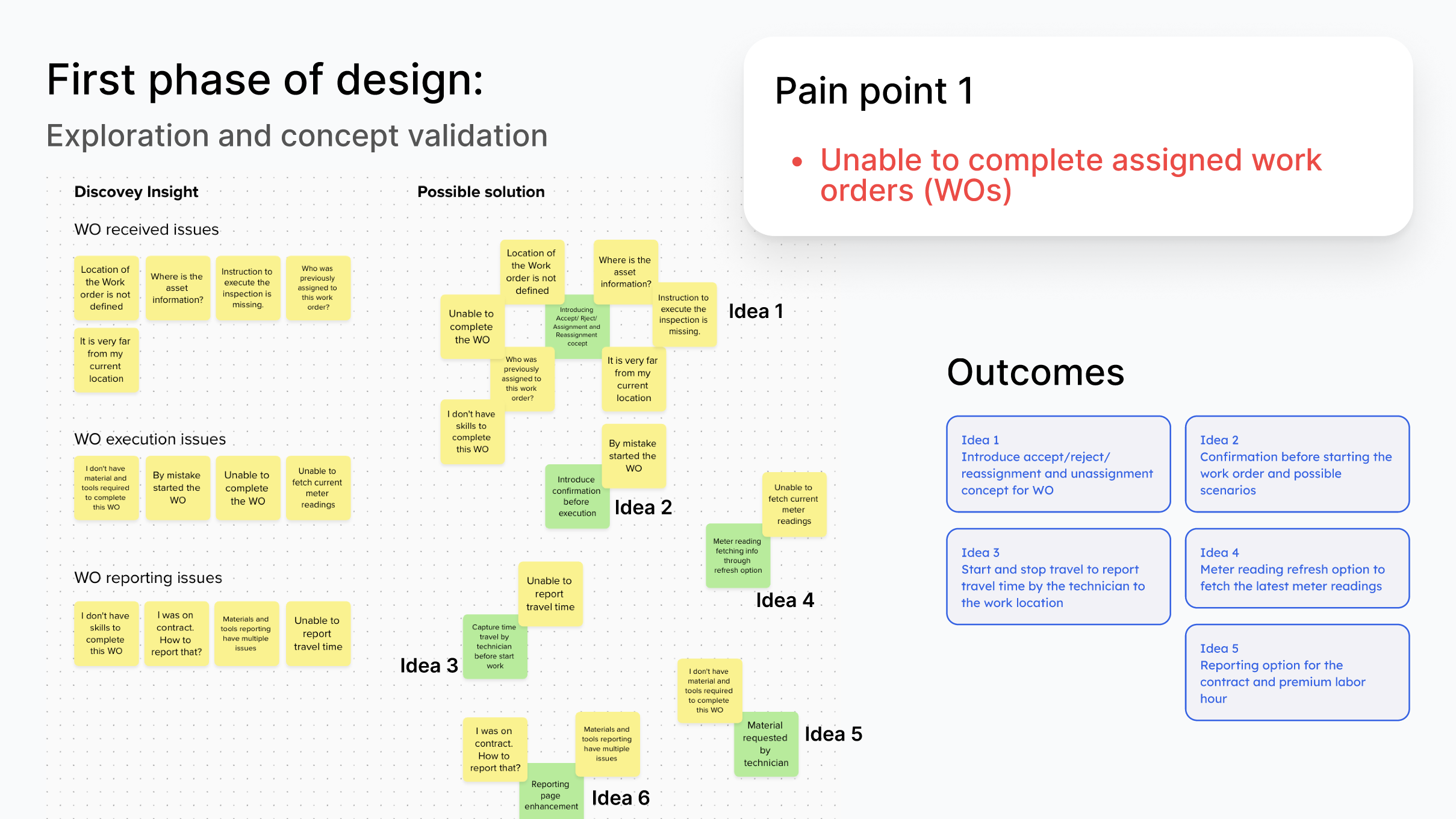
This was our highest-impact problem.
Dispatcher → Start Work → Report
Simple — but fragile and ambiguous.
Dispatcher → Start Travel → Reach Location →
Accept / Reject / Reassign → Log Travel Time → Report Completion
We introduced:
Ambiguity was removed.
Errors were prevented before they occurred.
One major constraint:
Reassigning work orders mid-execution complicated backend reporting.
Instead of pushing an idealized solution, we:
This allowed us to ship faster without sacrificing core usability.
We aligned fully with IBM’s Graphite design system.
Example:
Outcomes:
Beyond completion flows, we introduced:
We operated within Agile:
This reduced rework and accelerated stakeholder buy-in.
Before development:
During development:
This dramatically reduced post-release defects.
Due to tight timelines, usability testing occurred post-build.
Goal:
Technicians complete assigned tasks within 1 minute.
We conducted 5 testing rounds with enterprise customers including:
Key improvements from testing:
Each refinement further optimized execution speed.
After one year:
While not solely responsible for the 10% growth target, this initiative created undeniable momentum and directly demonstrated:
UX drives business growth.
IBM Maximo has a steep learning curve.
Documentation alone wasn’t enough — I had to deeply understand workflows and architecture.
Key learnings:
This experience strengthened my ability to:
If I were to extend this work further, I would:
Great UX is not just about clean interfaces.
It’s about:
This project reinforced a core belief:
When execution improves, growth follows.

Share:




Senior UX+UI Designer for designing complex B2B Enterprise Products


